Choosing where to buy in Hartford County can feel like balancing a dozen variables at once. You might want a shorter commute, more space, or a price that keeps your monthly payment comfortable. You also want confidence that the neighborhood you pick fits your daily life, not just your budget. In this guide, you will see how Hartford’s city core, the inner-ring suburbs, and the Farmington Valley suburbs compare on housing type, typical prices, commute patterns, and transit. Let’s dive in.
How to use this guide
Hartford County works best when you think in clusters:
- City core: Hartford — more condos and multifamily options, lower entry prices, strong walkability near downtown.
- Inner-ring suburbs: West Hartford, East Hartford, Wethersfield, Windsor, Newington — close-in single-family homes, town centers, and solid transit access.
- Farmington Valley: Farmington, Avon, Glastonbury, Simsbury — larger lots and homes, higher price bands, longer average commutes.
Use the snapshots below for a fast comparison, then focus on the trade-offs that matter most to you.
Prices and commutes at a glance
These recent market signals help frame expectations. They are snapshots, not fixed quotes, so plan to verify current medians before you write an offer.
- Hartford (city): Typical home values trail the suburbs by a wide margin. Recent indicators placed the city’s value index near the high $100,000s. Mean commute time is about 23 minutes, according to U.S. Census QuickFacts.
- Inner-ring examples: West Hartford’s market runs higher than the county average, with a price signal in the mid-to-high $400,000s. Wethersfield’s recent median sat in the mid-to-high $300,000s. Manchester (often a mid-range option) recently hovered around the low-to-mid $300,000s.
- Farmington Valley: Farmington showed a typical value around the mid-$400,000s; Avon often trends in the low-to-mid $500,000s; Glastonbury near the low-to-mid $500,000s; Simsbury around the low $500,000s. Average commute times tend to run in the mid‑20 minutes in this cluster. Farmington’s mean commute sits near 24 minutes in Census benchmarks, while Simsbury’s is closer to 26 minutes (see Farmington Census snapshot).
City core: Hartford
Housing and lifestyle
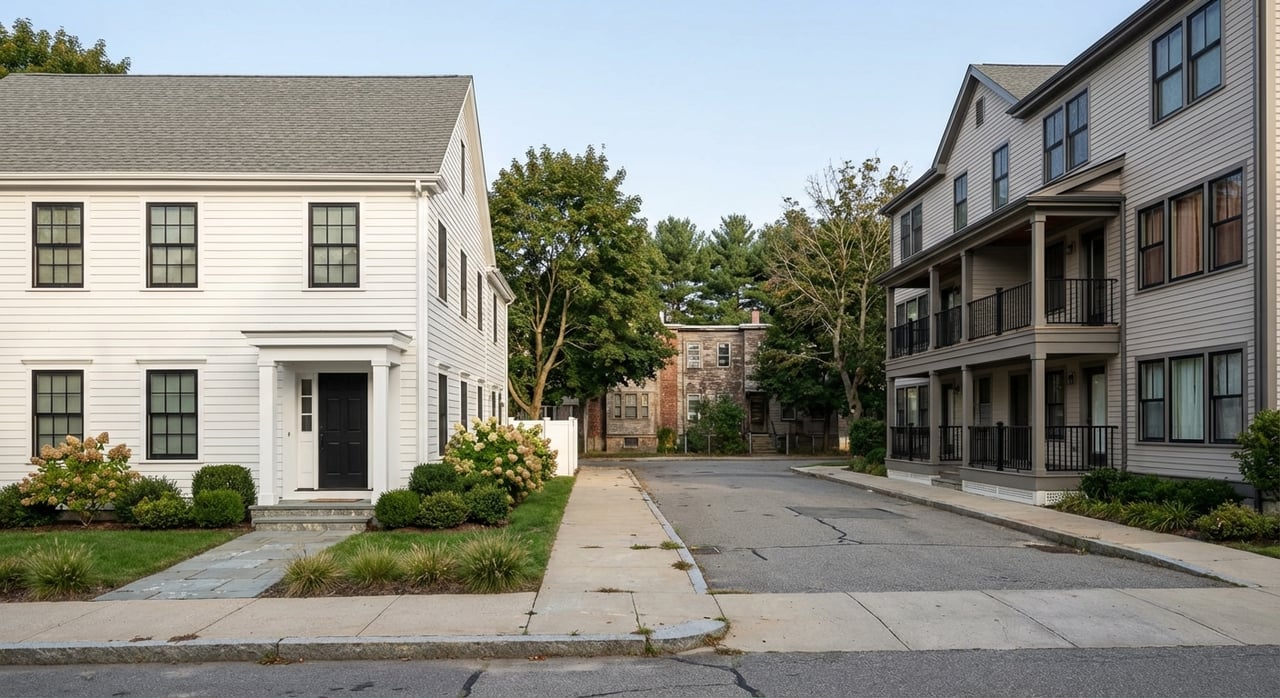
Expect a denser mix: condos, apartments, stacked flats, and pockets of historic single-family homes. If you want walkable downtown amenities and shorter local trips to work or entertainment, Hartford can be a strong fit. You will see more multifamily buildings and condo communities than in the suburbs.
Price and inventory signals
Hartford’s typical value index has been substantially below nearby towns. Entry prices often compare favorably for first-time buyers or downsizers looking for lower carrying costs. Inventory skews toward condos and multifamily properties, which can change your maintenance profile and monthly budget.
Commutes and transit
Inside the city, local trips are short. For regional commuting, most buyers rely on I‑84 and I‑91. If you want rail access, Hartford Union Station connects you to the New Haven–Hartford–Springfield corridor on the CTrail Hartford Line. Local and regional buses provide added coverage, with routes radiating into the suburbs.
Inner-ring suburbs: West Hartford, East Hartford, Wethersfield, Windsor, Newington
What to expect
You will find many mid‑20th‑century colonials, capes, and split levels on modest lots, plus townhouses and condos near town centers. West Hartford’s retail and dining hubs, including Blue Back Square and nearby shopping areas, concentrate services and restaurants. Yards tend to be smaller than in the outer suburbs, yet still private and practical for daily life.
Price and competition
This cluster often balances value and access. West Hartford shows higher typical values than most nearby towns. Wethersfield and Windsor can sit in mid-range territory. Competition can be brisk for move‑in‑ready homes near popular centers, so plan ahead on financing and offer strategy.
Commutes and transit
Drive times into Hartford usually fall in the 20 to 25 minute band, depending on the corridor and time of day. Transit access is a practical plus here. The region’s bus rapid transit, CTfastrak, links New Britain and Hartford and connects to CTtransit local routes across the inner suburbs. If you want to skip some highway driving, homes near CTfastrak stations or frequent bus routes can simplify your routine.
Farmington Valley and higher-amenity suburbs: Farmington, Avon, Glastonbury, Simsbury
Housing and lots
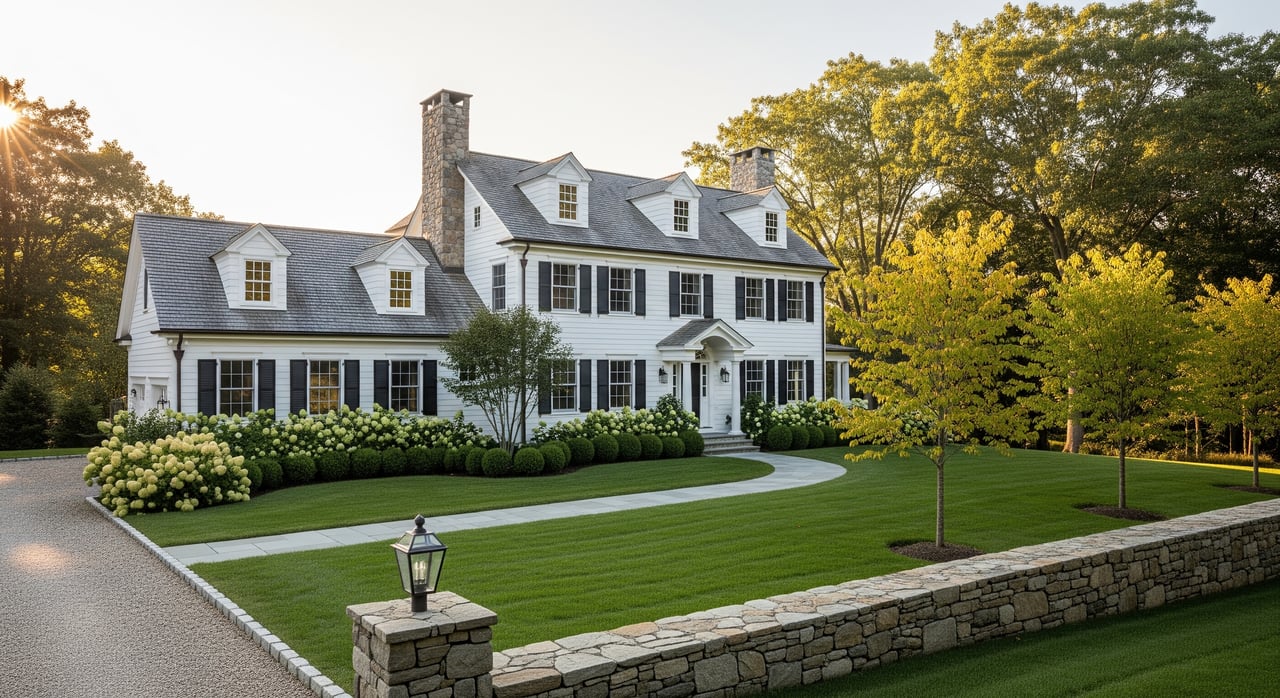
Expect more space. Many homes are larger, with quarter‑acre to multi‑acre lots more common than closer‑in towns. You will see a mix of newer subdivisions and historic village centers. Side streets tend to feel quieter, with more separation between homes.
Price signals
Recent indicators show higher typical values: Farmington around the mid‑$400,000s, Glastonbury and Simsbury around the low‑to‑mid $500,000s, and Avon often in the mid‑$500,000s. Buyers in this cluster tend to budget more for purchase price and property taxes in exchange for space and calmer streets.
Commutes and daily driving
Average commute times in parts of the Valley edge into the mid‑20‑minute range. Many residents drive via I‑84, Route 44, or Route 6. Transit is less dense than the inner ring, so plan on more driving for daily errands. If you travel often, note that northern suburbs can offer convenient access to Bradley International Airport.
Transit, highways, and regional access
- Bus rapid transit and local buses: CTfastrak ties into CTtransit’s wider network, improving access for inner‑ring towns and neighborhoods near stations.
- Regional rail: The CTrail Hartford Line connects New Haven–Hartford–Springfield and links to Amtrak and Metro‑North systems for broader trips.
- Highways: I‑84 runs east–west and I‑91 runs north–south. Route 9 and the Berlin Turnpike are key corridors. If rush‑hour driving will shape your day, test your route at your actual commute times.
- Air travel: Proximity to Bradley International Airport is a perk for frequent flyers, especially in northern suburbs.
Taxes, schools, and carrying costs
- Property taxes: Mill rates vary by town and can change your annual costs by thousands. Compare current rates on the Connecticut OPM’s official municipal mill‑rates page.
- Schools: Many buyers consider program offerings and resources when comparing districts. For a neutral starting point, review district materials such as West Hartford Public Schools’ curriculum and assessment page and the Connecticut State Department of Education’s EdSight profiles. Always verify policies and programs directly with the district.
Quick match-yourself checklist
Use this quick sort to narrow your search:
- You want the lowest purchase price and walkability: Start with Hartford’s city neighborhoods and condo options. Trade-offs include smaller yards and more multifamily inventory.
- You want shorter commutes with single‑family homes: Focus on inner‑ring suburbs like West Hartford, Wethersfield, Windsor, Newington, and East Hartford. Expect modest lots and strong access to transit.
- You want more space and a quieter setting: Explore Farmington, Avon, Glastonbury, and Simsbury. Plan for higher price points and more driving day to day.
- You prioritize transit access: Look near CTfastrak stations or Hartford Line stops to reduce highway time.
- You need to fine‑tune carrying costs: Compare each town’s mill rate, typical lot size, and likely maintenance needs for the home type you prefer.
How a local advisor helps you decide
Your best fit depends on price tolerance, commute habits, and how you live day to day. A hands‑on agent can help you weigh taxes, expected maintenance, renovation potential, and neighborhood trade‑offs before you commit. If you want clear guidance on pricing strategy, staging, inspections, and vendor coordination, connect with Tiziana Tremblay for a no‑pressure consultation. You will get practical advice rooted in finance and construction know‑how so you can buy with confidence.
FAQs
What are the key differences between Hartford, inner suburbs, and Farmington Valley for buyers?
- Hartford often offers lower entry prices and walkability; inner‑ring suburbs balance single‑family homes with shorter commutes and transit; Farmington Valley delivers larger lots and higher price points with longer average drives.
How do commute times compare across popular Hartford County towns?
- Census benchmarks show Hartford near 23 minutes, West Hartford around 22 minutes, Farmington near 24 minutes, and Simsbury closer to 26 minutes; verify your route at peak times using U.S. Census QuickFacts as a baseline.
Which areas are most transit-friendly in Hartford County?
- Neighborhoods near CTfastrak bus rapid transit stations and towns with Hartford Line rail access offer the strongest transit options for daily commuting.
Where can I check current property tax rates by town in Connecticut?
- Review the official mill‑rate listings on the Connecticut OPM website’s municipal mill‑rates page to compare towns.
What should frequent flyers consider when choosing a Hartford County location?
- If you travel often, living with 20 to 30 minute access to Bradley International Airport can simplify trips; northern suburbs typically offer the most convenient drives.